
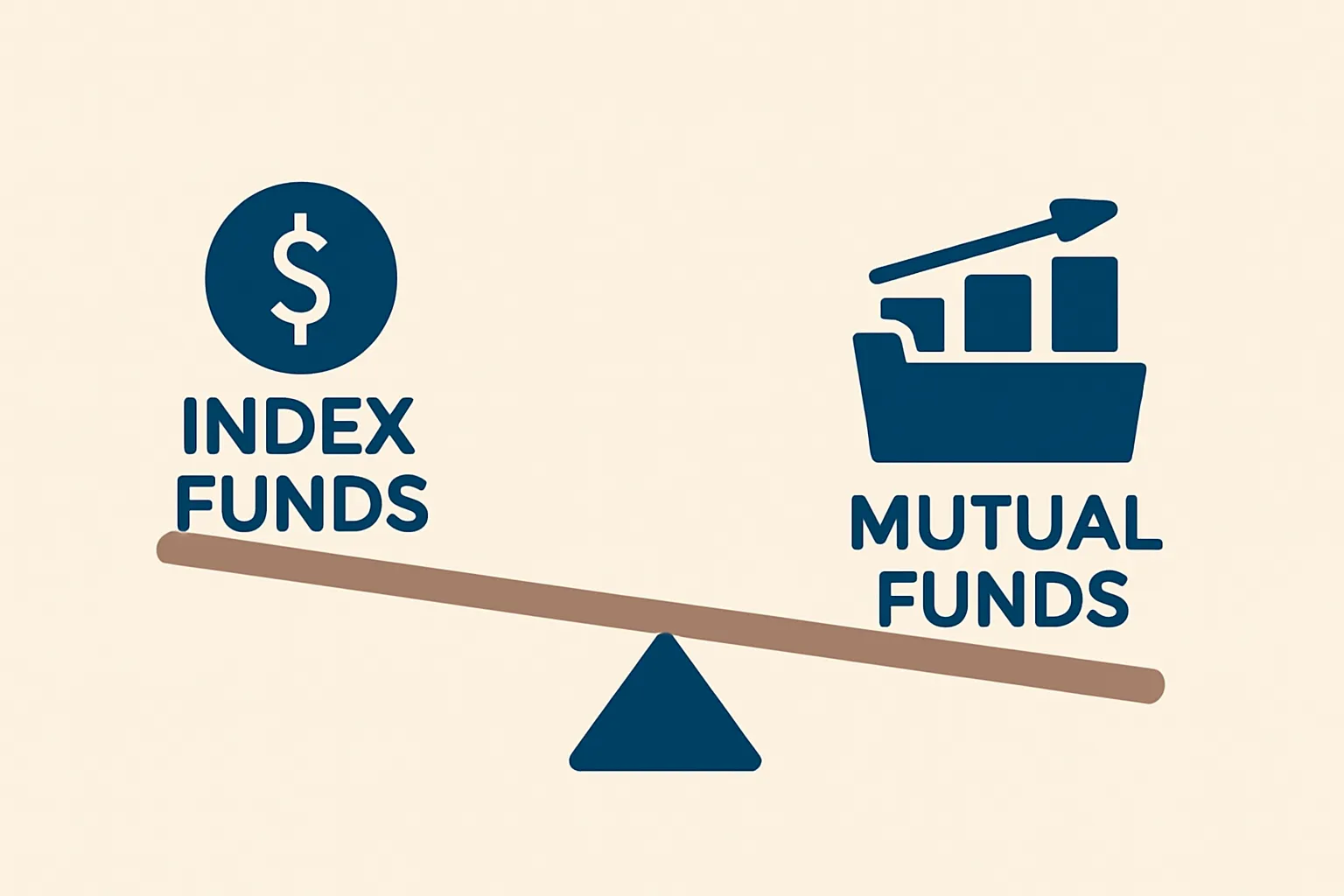
Index Funds vs. Mutual Funds: Which Is Better in 2025?
The debate over index funds vs. mutual funds is often framed as a fight between passive investing and active management. In 2025, the lines are blurrier than ever: there are index mutual funds, index-tracking ETFs, and actively managed mutual funds and ETFs. Investors face unprecedented access to low-cost products, near-zero trading commissions, and a rapidly evolving tax and regulatory landscape. The right choice is less about tribal loyalty and more about matching costs, goals, taxes, behavior, and time horizon to a coherent plan.
This comprehensive guide breaks down the nuances of mutual funds vs. index funds, explains how they work, clarifies performance myths, explores practical use cases, and concludes with a structured framework to help you decide which is better for you in 2025.
What Exactly Is an Index Fund?
How Index Funds Work
An index fund aims to match the performance of a specific market index—such as the S&P 500, the Russell 2000, or a total market benchmark—by holding the same securities in the same weights (full replication) or a statistically representative sample (sampling). The principle is simple: instead of paying a manager to choose winners, you accept the market return for a fraction of the cost.
Many index funds are offered as mutual funds and/or ETFs. The structure matters for taxes and trading, but the strategy—passively tracking an index—is the same. When people contrast index funds vs. mutual funds, they often mean index funds (passive) vs. active mutual funds, not the legal structure itself.
Types of Index Funds
- Market-cap weighted: The most common. Larger companies have bigger weights. Examples: S&P 500, MSCI ACWI.
- Equal-weighted: Each constituent has the same weight, increasing exposure to smaller firms.
- Factor or “smart beta” indices: Rules-based tilts toward factors like value, momentum, quality, low volatility, or size.
- Sector and thematic indices: Technology, energy, healthcare, clean energy, AI, etc.
- Bond indices: Treasuries, corporates, high yield, international bonds, inflation-linked securities.
- ESG/sustainability indices: Incorporate environmental, social, and governance screens.
Regardless of flavor, the hallmark of index-tracking funds is low cost, high transparency, and broad diversification.
What Is a Mutual Fund?
Active Mutual Funds
A mutual fund is an investment vehicle that pools investors’ money to buy a diversified portfolio of securities. Many mutual funds are actively managed, meaning a professional management team selects securities in an attempt to beat a benchmark after fees. Active mutual funds often have higher expense ratios, more trading (higher turnover), and more variable outcomes relative to their benchmarks.
Passive Mutual Funds
Mutual funds can also be passive. An index mutual fund is simply a mutual fund vehicle that tracks an index. This is why the phrase index funds vs. mutual funds can be confusing: structurally, you can have both index mutual funds and active mutual funds. The real split is passive vs. active.
In 2025, many investors choose between:
- Index mutual funds (passive strategy, mutual fund structure)
- Index ETFs (passive strategy, ETF structure)
- Active mutual funds (active strategy, mutual fund structure)
- Active ETFs (active strategy, ETF structure)
Your decision hinges on cost, taxes, convenience, and investment philosophy, not strictly on legal form.
Cost Structure: The Hidden Engine of Outcomes
Over long horizons, fees compound almost as powerfully as returns. When comparing mutual funds vs. index funds, cost is often the deciding factor.
- Expense ratios: Index funds (mutual funds or ETFs) frequently charge 0.02% to 0.10% annually for major asset classes, while active mutual funds often charge 0.50% to 1.00%+. That gap can translate into tens of thousands of dollars over decades.
- Trading costs and turnover: Active strategies trade more, incurring bid–ask spreads and market impact. Index funds usually have lower turnover, though some factor indices rebalance more often.
- Sales loads: Many modern platforms have eliminated front-end and back-end loads, but legacy share classes still exist. Low-cost index funds rarely carry loads.
- Cash drag: Active funds sometimes hold larger cash positions, which can lag in rising markets.
- Securities lending revenue: Some index funds lend securities and share revenue with investors, subtly improving net returns; policies vary by provider.
The bottom line: low fees increase the odds of success. When you capture the market return minus a tiny fee, you force active competitors to overcome a fee hurdle—year after year.
Performance Reality Check: What the Data Suggests
Over multi-year periods, a substantial share of active mutual funds underperform their benchmarks after fees. Survivorship bias, style drift, and market cycles make the picture noisy, but the signal is consistent: finding the few persistent outperformers is hard in advance.
When Active Funds Can Win
- Less efficient markets: Niche segments (micro-caps, certain international small-cap, specialized credit) may offer more mispricings.
- Capacity-constrained strategies: Skilled managers who cap assets can preserve alpha, though opportunities may be limited.
- Bear markets and dislocations: Skilled risk management, cash, or hedges can cushion declines, albeit inconsistently.
- Tax-aware active: In taxable accounts, some active strategies harvest losses and defer gains, narrowing the tax disadvantage.
When Indexing Shines
- Highly efficient markets: Large-cap U.S. equities are fiercely competitive; low fees dominate.
- Long horizons: The compounding effect of lower costs, fewer mistakes, and broad diversification accrues steadily.
- Behavioral discipline: Simple, rules-based exposure reduces the urge to chase recent winners.
The crucial insight for index funds vs. mutual funds in 2025 is not that active never works—but that consistent, net-of-fee outperformance is rare and difficult to identify before the fact. Indexing gives you the market’s average return at minimal cost, which, paradoxically, tends to be above the average investor’s realized return due to fees and behavior.
Risk Considerations: Different Flavors of Risk
In the mutual funds vs. index funds conversation, risk shows up in different ways.
- Tracking error: Index funds may deviate slightly from the benchmark due to sampling, fees, and rebalancing mechanics. Typically small for broad indices.
- Active risk (alpha risk): Active funds can stray from their benchmark (high active share), which increases the variability of outcomes—both positive and negative.
- Concentration risk: Cap-weighted indices can become top-heavy in a few mega-cap names. Equal-weight or factor indices may spread exposure differently but bring other risks.
- Liquidity risk: Smaller, specialized active funds may hold less-liquid securities; stress can widen spreads and cause larger NAV deviations.
- Manager risk: Key-person risk and strategy drift affect active mutual funds; talent turnover can materially change outcomes.
- Sequence-of-returns risk: For retirees, returns arriving in a bad sequence can cause portfolio depletion. Indexing doesn’t eliminate this; thoughtful withdrawal and allocation do.
The right choice balances diversification, cost, and your tolerance for variability in outcomes.
Taxes in 2025: Efficiency Matters
Taxes are an underappreciated edge for the index funds vs. mutual funds comparison, especially in taxable accounts.
- Capital gains distributions: Mutual funds (active or passive) can distribute capital gains annually when they sell appreciated holdings. Index mutual funds tend to distribute less due to lower turnover.
- ETF tax efficiency: Many ETFs can use in-kind redemptions to minimize capital gains distributions, making them very tax-efficient.
- Turnover and harvesting: Passive funds typically have lower turnover, deferring gains. Some active funds emphasize tax management, but results vary.
- Asset location: Holding tax-inefficient assets (e.g., high-yield bonds, REITs) in tax-deferred or tax-exempt accounts and tax-efficient index equity in taxable accounts can improve after-tax returns.
A 2025 trend worth noting: ETF share classes and conversions continue to proliferate, giving investors more ways to obtain index exposure with minimized taxable distributions. While tax rules can evolve, the structural advantage of low turnover and in-kind mechanisms has persisted.
Behavioral Advantage: The Quiet Power of Simplicity
Many investors underperform their own funds by attempting to time entries and exits. The simplicity of a low-cost index strategy can reduce behavioral mistakes:
- Fewer moving parts: Less temptation to jump between hot funds.
- Rules-based rebalancing: Systematic, unemotional discipline.
- Broad diversification: Reduces regret from missing narrow winners.
That said, investors who can judge managers objectively, tolerate tracking error, and stick with a process through inevitable slumps may benefit from a judicious mix of active mutual funds.