
Overview: What Is Compound Interest?
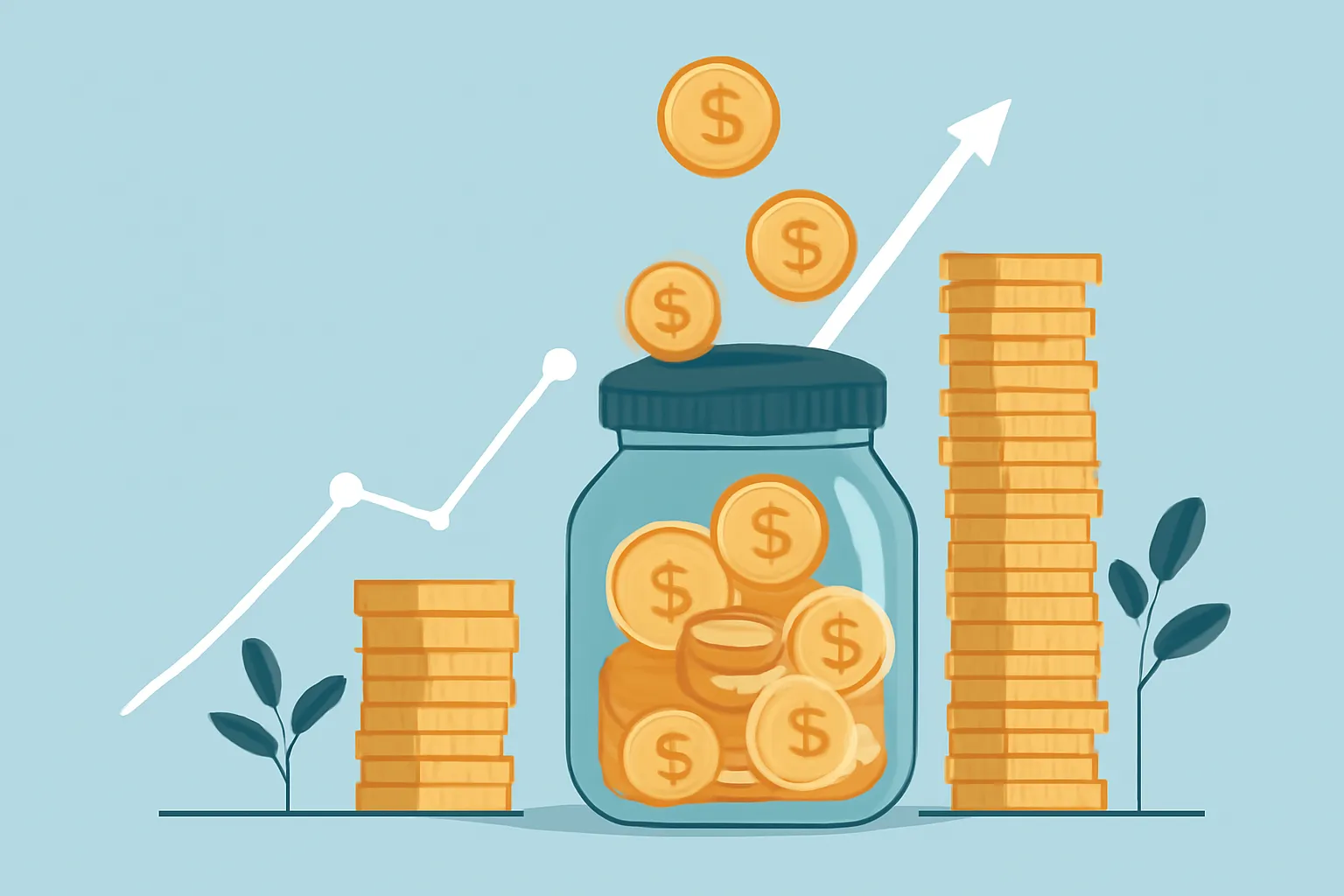
If you have ever wondered, what is compound interest? you are asking one of the most important questions in personal finance and investing. In simple terms, compound interest is the process by which your money earns interest, and then that interest itself starts earning more interest over time. This is often called the power of compounding, and it’s why small, consistent contributions can snowball into substantial sums—given enough time.
Another way to phrase it is: What exactly does compound interest mean? It means that instead of just earning interest on your original amount (known as the principal), you also earn interest on the interest previously added to your account. The effect accelerates as the number of compounding periods increases and as the time horizon extends. In fact, compounding is central to everything from retirement planning and college savings to understanding how credit card debt can balloon if left unmanaged.
People often hear the phrase, “compound interest is your best friend as an investor, but your worst enemy as a borrower.” That’s because the same mathematical mechanism that fuels exponential growth of your investments can also cause debts to climb rapidly when interest compounds against you. In both cases, understanding the rules of compounding empowers you to make smarter decisions.
Formal Definition and Core Idea
The most concise answer to What is compound interest? is this: Compound interest is interest calculated on the initial principal plus the accumulated interest from previous periods. Unlike simple interest—which is based only on your original principal—compound interest “compounds,” or layers, period after period.
This concept appears in savings accounts, certificates of deposit (CDs), bonds (through reinvestment), mortgages (through amortization schedules), student loans, credit cards, and retirement accounts. Every time interest is added and left in the account, the base on which future interest is calculated grows.
The Compound Interest Formula
The standard compound interest formula answers the question: How much will my money grow to over time? When interest compounds a certain number of times per year, the future value A is:
A = P(1 + r/n)n·t
- P = principal (the initial amount)
- r = annual nominal interest rate (as a decimal, e.g., 0.05 for 5%)
- n = number of compounding periods per year (e.g., 12 for monthly, 365 for daily)
- t = time in years
- A = amount after t years (future value)
In this formula, interest is applied n times per year, and the exponent n·t reflects how many compounding periods occur during the total time t.
Continuous Compounding
When interest compounds continuously—an idealized math concept but sometimes used in finance—the formula becomes:
A = P · er·t
Here, e is the mathematical constant approximately equal to 2.71828. Continuous compounding produces slightly more growth than daily, monthly, or quarterly compounding at the same nominal rate, but the difference narrows as n becomes large.
Effective Annual Rate (EAR or APY)
The effective annual rate—often called APY for savings products—shows what you truly earn in a year once compounding is accounted for. It answers a version of the question, What is compound interest in yearly terms? If the nominal rate is r and compounding occurs n times per year:
EAR = (1 + r/n)n − 1
For continuous compounding, the effective annual rate is EAR = er − 1. Comparing APYs (not just nominal rates) helps you judge which savings product truly pays more.
APR vs. APY
Financial products may quote APR (Annual Percentage Rate) or APY (Annual Percentage Yield). As a borrower, your credit card might show an APR, which often does not include compounding explicitly in the quote, while the actual daily compounding is embedded in how balances grow. As a saver or investor, APY incorporates compounding, so it generally appears higher than APR at the same nominal rate. Comparing apples to apples (APR vs. APY) is crucial.
How Compounding Frequency Changes Results
Different compounding frequencies—annually, semiannually, quarterly, monthly, daily, or continuously—change how quickly balances grow. If the nominal rate is fixed, more frequent compounding generally leads to higher effective returns. For instance, 5% compounded annually yields slightly less than 5% compounded monthly, which yields slightly less than 5% compounded daily, and so on.
However, the incremental benefit diminishes as compounding becomes very frequent. The difference between daily and continuous compounding at typical interest rates is relatively small, while the jump from annual to quarterly or monthly compounding is more noticeable.
Working Backward: Solving for Time or Rate
Sometimes you want to answer: How long will it take to reach a goal? or What rate is needed to grow to a target?
- Time to reach a target A: t = ln(A/P) / [n · ln(1 + r/n)]
- Rate needed: r = n · [(A/P)1/(n·t) − 1]
With continuous compounding:
- Time: t = ln(A/P) / r
- Rate: r = ln(A/P) / t
What Does Compounding Look Like Over Time?
Early in the journey, growth seems slow because the interest earned is small relative to the principal. Over time, as interest adds to the base, the growth accelerates. This is the essence of exponential growth. If you’re asking, what is compound interest really doing behind the scenes?—it’s continuously increasing the amount that future interest is calculated on, which creates a curve that grows steeper over time.
Examples: Step-by-Step Compound Interest Calculations
Let’s explore a series of practical scenarios to illustrate compound interest explained in different contexts. Unless noted, these examples ignore taxes, fees, and special conditions for simplicity.
Example 1: Savings Account with Monthly Compounding
Suppose you deposit $10,000 into a savings account that pays a 5% annual nominal rate compounded monthly (n = 12). You plan to leave it untouched for 10 years (t = 10).
Using A = P(1 + r/n)n·t:
A = 10,000 × (1 + 0.05/12)12 × 10 ≈ 10,000 × (1.0041667)120
The result is approximately $16,470. Your money grew by about $6,470, and that difference includes interest on interest, not just interest on your original deposit.
Example 2: Certificate of Deposit (CD) with Quarterly Compounding
You invest $5,000 in a 2-year CD at a 4.2% nominal rate, compounded quarterly (n = 4).
A = 5,000 × (1 + 0.042/4)4 × 2 ≈ 5,000 × (1.0105)8 ≈ $5,434
The quarterly compounding boosts the effective return slightly compared with annual compounding at the same nominal rate.
Example 3: Credit Card Debt with Daily Compounding
Suppose a credit card has an APR of 18% with daily compounding (n ≈ 365). If you start with a $3,000 balance and do not make payments for one year (not recommended), the balance would grow to:
A = 3,000 × (1 + 0.18/365)365 ≈ 3,000 × (1.00049315)365 ≈ 3,000 × 1.1967 ≈ $3,590
This demonstrates how compound interest works against you when you carry high-interest debt—especially with frequent compounding.
Example 4: Continuous Compounding Illustration
If you invest $2,000 at a 6% continuous compounding rate for 5 years:
A = 2,000 × e0.06 × 5 ≈ 2,000 × e0.30 ≈ 2,000 × 1.34986 ≈ $2,700
Continuous compounding yields slightly more than daily or monthly compounding at the same nominal rate, but not dramatically more.
Example 5: Effective Annual Rate (APY) Comparison
Two banks offer savings accounts with a 5% nominal rate. Bank A compounds annually (n=1), and Bank B compounds monthly (n=12).
- Bank A APY: (1 + 0.05/1)1 − 1 = 5.00%
- Bank B APY: (1 + 0.05/12)12 − 1 ≈ 5.116%